
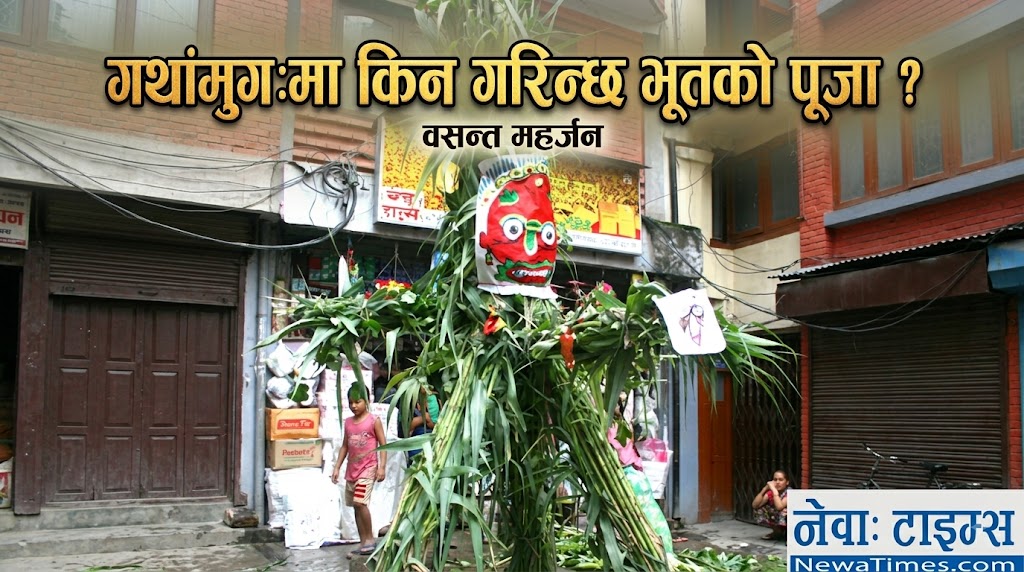
The Gathamug festival is celebrated in Newar society on the Chaturdashi of every Shravan Krishna month. Gathamug is not directly related to religion, but nowadays many stories have been woven about it.
For example, since people walk around with a bell hanging from their ears so as not to hear the words of God, Gathamug has also been given a different name, ‘Ghantakarna’. It is also heard as ‘Gathemangal’. However, all these are cultural deviations and misinterpretations of this festival.
Some cultural festivals related to Hinduism and Buddhism have been found to have grown differently in Newar society. The reason for this is the adoption of external cultures that are compatible with the original values, beliefs and traditions here.
In fact, Gathamug can be a key to understanding primitive Newar culture. However, even those who talk and write about Newar culture have not reached a consensus on this. Its main point is the Hindu or Buddhist perspective on the festival. However, what can be said about the culture that developed at the local level even before the emergence of these religions? How to analyze it?
Some cultural festivals related to Hinduism and Buddhism have been developed differently in Newar society. The reason for this is the adoption of external culture that is compatible with the original values, beliefs and traditions here.
What is Gathammugah?
The society often accepts the existence of ghosts. Ghosts are considered as negative forces, but Gathammugah gives the message that ghosts can be tamed through Tantra practice and used for the benefit of society.
In Newar society, the myth of ‘Khyak’ is also an aspect of culture, but it is different from ghosts. In cases where someone eats in an unusual way, it is said that ‘Bhootle Khae’ (ghost has eaten) and in cases where an impossible task is completed, it is said that ‘Bhoot Dubyuwathen’ (ghost has entered) (as if a ghost has entered). To understand Gathamug, one must understand this concept.
When labor is required in large quantities during the rush of planting, the practice of inviting ghosts to farmers was a tradition in Newar society. In Kathmandu, this act of inviting ghosts was done collectively on Akshaya Tritiya, while elsewhere it was done individually in one's own field before planting. But now this practice is disappearing.
It is believed that ghosts invited through sadhana come to human settlements and enter every house. It is customary to express gratitude to the ghosts for giving them the power to complete even the most difficult task of planting without anyone noticing. However, due to the fear of unlucky things happening if a ghost is kept permanently in a house or village, a replica of the ghost is made and bid farewell to it in a formal manner on the Chaturdashi of Shravan Krishna.
On this day, when ghosts are worshipped and bid farewell, they bathe, wash, and clean the house in the morning. It is also believed that wearing an iron ring will get rid of ghosts. Until a few decades ago, iron workers used to sell iron rings in the villages on this day.
On this day, Gathamug made of reed bundles is erected in the villages from the morning. In some villages, a female ghost is made, while in others, a male ghost. To distinguish between female and male ghosts, the shape of the vagina and genitals is given. It is also seen that faces are written on a cloth or paper and pasted.
In Kirtipur, there is a custom of making a ghost like a human, initially small in the form of a child and then gradually larger, and taking it to the riverbank in the evening to die. There is also a custom of hanging a doll on the body of the Gathamug, thinking that a ghost may have entered the doll made of cloth. In Bhaktapur, instead of reeds, the gathamugah is made and burned.
While the gathamugah is being made and burned in the tol, two bundles of chhwali are being placed in a corner of the house, wrapped in a cloth. At other times, unusual items such as meat, blood clots, chaff, chavkabaji (chiura dust), leaves of various plants, and bread made of flour are considered indispensable for the worship of ghosts.
After the gathamugah of the tol is burned, the homemade chhwali ghost is set on fire and taken outside to the chhwas (a cultural site often set aside at a crossroads) to be burned. The person who burns the chhwali repeatedly calls out in a loud voice, "Ha bhoot," as he walks towards the crossroads. The ghost of another person is washed away by another person in a drain under or near the house.
The person who is being washed away is allowed to enter the house only after washing his hands and feet and sprinkling water. Samebaji is fed inside the house. The work of hammering a swakin or nyakin (three-faced or five-faced nail) in the porch of the house is also done at this time. Then the door is closed. And for some time, going out and coming in from the house is stopped.
There is no influence of Hinduism or Buddhism in all the activities related to Gathamugah. But it is found that both Hindus and Buddhists have been celebrating this festival traditionally.
A glimpse of primitive culture is seen in the Gathamugah culture. This glimpse or influence guides other festivals and religious practices prevalent in Newar society. Not finding the meaning of which, even the most sceptical scholars get confused. And, as mentioned above, they end up falling into contradictions.

More from Basanta Maharjan




Comments (0)
No comments yet
Be the first to comment!
Write a Comment