
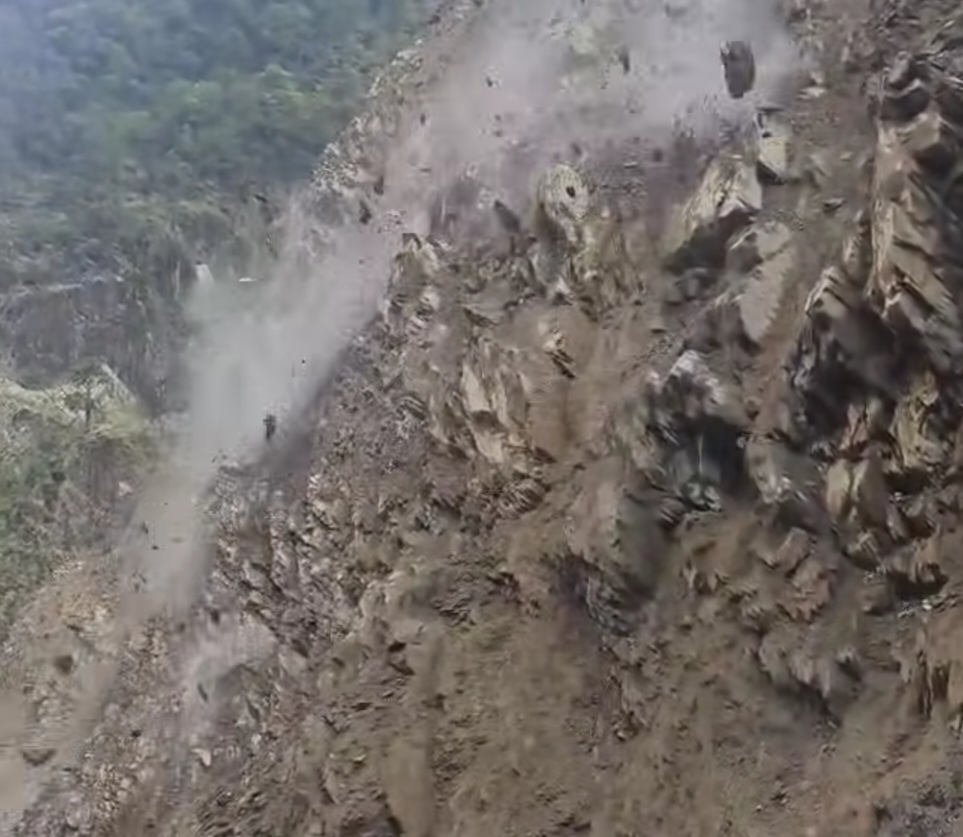
Kathmandu, Assage 7. Dashain has entered the courtyards of Nepalese people. At least once in Dashain, many people want to go home, and prepare accordingly and leave Kathmandu in millions. The desires and plans of those who want to go home to celebrate Dashain are unlimited, but the roads that have gone from place to place on the highway have created problems.
For a few days, many commuters suffered due to a landslide near the Tuin Khola bridge on the Mugling-Narayanghat road. The travelers were stranded on the road for almost two days as the rocks, big rocks, and loose mud kept falling from the mountains in the road. Due to the tireless efforts of the local bodies, security mechanisms, many passengers continued towards their destination even though they were lax.
Since last year, a landslide near the Tuin Khola bridge on the Mugling-Narayanghat road had blocked the road traffic. From today, the road has been blocked again due to a dry landslide in Benighat Rorang Rural Municipality-10 Jawangkhola of Dhading. According to the District Police Office, Dhading, due to the road blockade, the Prithvi Highway is currently stopped between vehicles entering and exiting Kathmandu.
According to the notification issued by Road Division Bharatpur today on 7th of Asajj, Muglin-Narayanghat road is being cleaned by machines deployed at the landslide site near Tuin river. There is a problem in bringing more equipment and fuel to the site as drivers park their vehicles in a disorderly manner. Under the Muglin-Nagadhunga road section, a landslide occurred near Jawang Khaela, blocking the road on both sides.
Engineer Shiv Khanal has mentioned some information about the current landslide in Tuinkhola catchment on his Facebook page. According to Khanal, regarding the road upgradation plan, in 2015, work was being done to upgrade the former intermediate lane of the Mugling-Narayanghat road to a dedicated double lane. Under the Nepal India Regional Trade and Transport Project (NIRTTP) under the Ministry of Commerce and Supply, the plan to upgrade the Mugling-Narayanghat road as a collaboration aimed at reducing the transit time of trade between Nepal and India was in the implementation stage. The World Bank was the development partner and donor partner of the plan.
According to Engineer Khanal, since the cost estimate had to be prepared within the limits of the loan amount, 3 ICB contracts were conducted to maintain the old bridge as it is and only improve the Mugling-Narayanghat road in the current condition without including the slope stabilization work.
Geographical structure of Mugling-Narayanghat road
Let's also talk about the physical structure of Mugling-Narayanghat road. The geology of the Muglin-Narayanghat road section is considered to be one of the most complex geological formations in central Nepal. According to Khanal, the area of this road from Muglin to Dasdhunga is the peak area of the Mahabharata Synclinorium, which has extended from the east of the Kathmandu Valley. This means that the region was under extremely high pressure during the geological past, as evidenced by the presence of hard layers. Passing through the Jogimara region, it crosses along the banks of the Kali River at about the Mugling-Narayanghat road area and continues westward spreading in the east-west direction of the Trishuli River.
The region has a rifted zone, several faults and thrusts within an "aerial distance" of less than 15 km. There are at least 4 thrusts and faults zones in the Muglin to Dasdhunga section, which are likely to become weak zones in sub-Himalayan areas like Nepal. This is why the excavated, sloped part of the road has many cracked stones on the surface at various places.
According to Khanal, one of these four thrusts and fault zones appears to originate near the Budhigandaki river, Benighat and crosses the Trishuli river thus crossing the Mugling-Jalbire-Seti Dobhan area of the Mugling-Narayanghat road into the high Jekhim area with very weak geological structure.
Why was it not possible to make the Mugling-Narayanghat road a landslide-free road?
Although the contract was awarded to upgrade the geographical structure of the Mugling-Narayanghat road as mentioned above, the construction of bridges was not included. According to Khanal, the cost of slope stabilization work on a road with a geographical structure like the Mugling-Narayanghat road is 3 to 5 times the cost of the road (pavement, structure and sewerage). Also, studies show that the cost will be 5 to 10 times more if the problem occurs near Tuin Khola Bridge. This kind of geological situation was also described in the report. Due to the limited amount of money borrowed, expensive methods could not be chosen. In the words of Khanal, more attention was given to the geological improvement by keeping the bridge and slope stabilization.
Was there any landslide prevention work on Mugling-Narayanghat road in the past?
According to Engineer Khanal, a lot of work has been done to prevent landslides on Mugling-Narayanghat road in the past and it has been successful to a large extent. In the first contract, there was a good arrangement of the engineering works. By awarding 3 ICB contracts, landslide prevention work at 32 places (rock netting, rock belting, rock anchoring etc.) and 4 bridges (Dasdhunga, Khani, Mauri and Jalbire) have been completed. Some local and foreign students have chosen the slope stabilization work of Mugling-Narayanghat road for direct and on-site visit as a thesis of MSc and academic degree, and Khanal himself has said that more than 20 foreign students have provided its data.
Was the landslide prevention work done in the past enough?
According to Engineer Khanal, the work done for the landslide prevention was not enough and as discussed above, landslide prevention work is never enough on the road that is physically very dangerous. For this, it is necessary to arrange a tunnel, which is several times more expensive. Therefore, such mountain roads, no matter how big or small, can never be free from landslides during the rainy season. The cost-effective solution is to clear the landslide and construct the road. In our country, 5-10 lakhs worth of roads dug above the highway to go to villages are making such problems even more complicated. Some major and busy roads of the world are also victims of the same problem as ours.
According to Engineer Khanal, after the slope stabilization work carried out in different stages in the past on the Mugling-Narayanghat road, the landslide-prone areas like Seti-Dobhan, Ghuwane, Baludhunga, Jalbire, Panch Kilo, Char Kilo, Tope Khola, Namsi Khola, Kali Khola, Chepang Danda, which are prone to landslides, have been controlled to a large extent. This does not mean that there will never be landslides. It may fall but it will not happen like in the past unless there is an extreme situation. For the past 2-3 days, the road was closed due to a landslide near the Tuin Khola bridge on the Mugling-Narayanghat road. The area where the landslide has occurred now is not an area identified as a danger or landslide area in the past because the geological condition there was considered to be relatively hard rock. Khanal mentions that the problem has arisen when the approach road towards Narayanghat of Tuin Khola is cut from behind.
He mentions, "I want to say one thing in response to the question asked by some experts and engineer friends on Facebook that Nepali engineers have made roads that will not cause landslides: "Nepali engineers are also capable of making roads that do not cause landslides. However, in a dynamic geographical area like Mugling Narayanghat, engineering solutions can only be temporary. Also, with limited resources and economic conditions like ours, the state cannot invest enough to build roads in geographically vulnerable areas. "
In a country with limited resources like ours, it is the biggest tragedy to openly seek solutions to all possible problems in advance and not be able to do so. There is a situation where strengthening and strengthening works should be carried out only after the basic needs are met. The roots of the problem are not being able to move forward creatively while giving nature a choice, and the management of resources is also slow. Today's need is to identify these problems and move forward.

More from Amika Rajthala




Comments (0)
No comments yet
Be the first to comment!
Write a Comment