
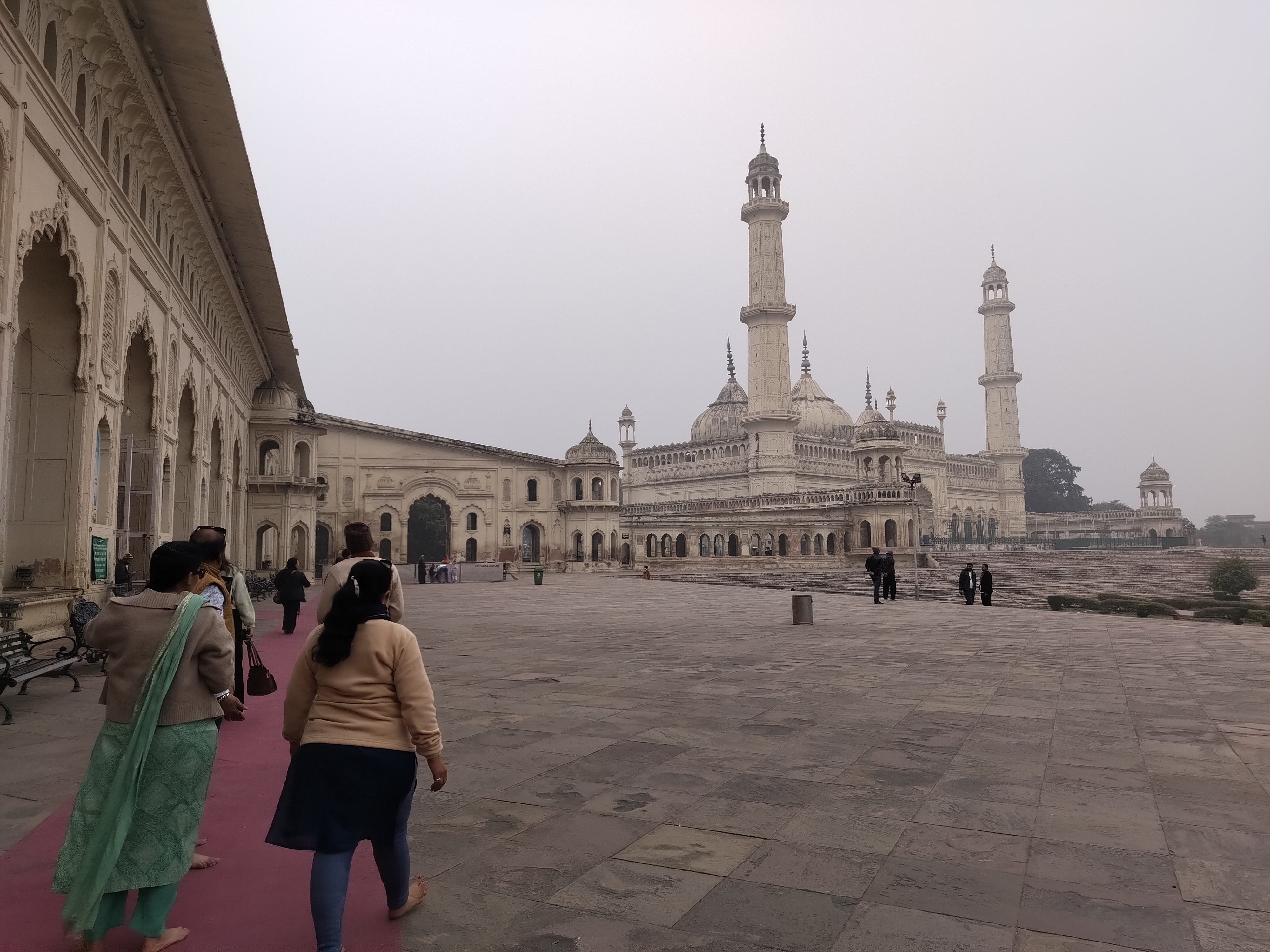
During our journey to various places in India under the Informal Buddhist Education Campaign, our second stop was Lucknow. While staying at Sitapur Road in Lucknow, the locals told us that Bhool Bhulayiya is nearby, it can be reached in 10-15 minutes.
In the morning, we had tea and lunch, and then went to Delhi only after returning after having lunch. As per the plan, a group of about 26 people set out on a morning walk, making Bhool Bhulayiya their destination. When we were told that we had 2-3 kilometers left, the group of six people boarded a tempo and went on foot.
Lucknow, the capital of the Indian state of Uttar Pradesh, is world famous for its historical, cultural and architectural heritage. One of the most famous and attractive structures among them is Bhool Bhulayiya, which is located within the Bara Imambara complex. This place attracts tourists due to its intricate maze, mysterious structure and unique architecture.
Historical Background of the Maze
The Bara Imambara with the Maze was built in 1784 AD by the order of Nawab Asaf-ud-Daulah of Awadh. At that time, there was a severe famine and drought in the Awadh region. The Nawab started the construction of this magnificent structure with the aim of providing employment to the people. Thus, the Maze, which was completed in 14 years, is not only a model of architecture but also a historical symbol associated with social welfare.
The term Nawab is often used to refer to a self-styled ruler. When I was a child, when I was in school, I heard about a self-styled Nawab who was caught by an attacker while waiting for a servant to get his shoes done. This teaches a good lesson in self-reliance. When you get lost in the maze, you realize that the Nawab is from this maze!
Structure and structure of the maze
When you hear the word, you feel confused and lost once you get there. Before going there for the first time, I also thought that the maze was an old park where you could go and have fun, like that, but it wasn't. Hidden inside the Bada Imambara (main building) in Lucknow, Uttar Pradesh, India, is a maze with a hundred paths.
The four-story Bada Imambara and the structure of the maze have amazed tourists and architects who have visited there for two centuries. When you enter the Bada Imambara, there is only one large hall, and around it are various historical paintings, statues and doors. Those who go without a guide get confused because they cannot find out which door is the right one to enter. Initially, our group also entered thinking that we would go without a guide, but after taking a look around the Imambara hall, we wondered where to go and what to see next. We were confused, we did not know which door to enter and we were also afraid that we would get lost if we entered through any door. Looking at the structure there, we could not understand much and started looking for a guide.
Even when we went for the second time, we decided that we could not go without a guide, so we started looking for a guide from the beginning.
In fact, many of the doors on the ground floor are just for guidance. There are also five or six doors in one place on the upper floors, it is difficult to distinguish which is the right one and which is the wrong one. Finding the right path and door for outside tourists is a very difficult task.
The Bada Imambara is built without any pillars, and its hall is spread over 170x55 feet. This building, which is up to the fourth floor, is supported by a 15-foot wall, and from inside this wall, a two-foot-wide staircase and path are made inside the maze, and open doors that allow you to go anywhere. You can go directly to the roof of the building by going completely outside the Bada Imambara building and climbing 84 two-foot-wide stairs from the right side of the same building, but the attraction of this building is that you enter through various doors and find your way forward, so anyone can get lost in the maze.
Since many of the paths look similar to each other, a person entering for the first time can easily get confused. The guide showed us the tunnel-like doors that spread out in all directions at the beginning and said, “Which door do you want to go through, but only one of these doors can lead to the right path, the rest will trap you, get you lost, get lost? But don’t be afraid, we can and will get you out of any place you are lost here.”
The most interesting aspect of the maze is its air circulation system. Without a traditional air conditioning system, the environment here remains cool in summer and relatively warm in winter. This reflects the technical skill and foresight of the architects of the time.
There are hundreds of interconnected paths and doors inside the maze, some of which can lead you to another place instead of taking you to the desired destination. Some of these paths lead us to windows, from which you can see a wonderful view outside. These windows are not only for the best view of the outside, but these windows also act as today's CCTV cameras, meaning that if you look through the window of the labyrinth, which is located about two hundred meters away, you can clearly see who entered the main door and who left. But a person coming from the outside cannot even know that he is under surveillance or that someone is watching him. The window through which he is being watched is not visible from the outside. Not from that window

More from Amika Rajthala







Comments (0)
No comments yet
Be the first to comment!
Write a Comment