

I often wonder, how history gets lost and why stories grow in the form of myths? A time has been lost on the Puranas of Hinduism, what are these? Hindus consider Puranas as real events, but they do not get the status of history. Not only Puranas, but also Ramayana and Mahabharata do not get the status of history. Finally, I understood that if you start using history to make it fun and popular and to fulfill your own purpose, it gradually starts changing its meaning and becomes a myth. I am a scholar of history and I have to follow the discipline of archaeology. I am not allowed to get involved in stories and myths. I am not allowed to go beyond the boundaries of history. Just like searching for Sita within myths and legends, I am allowed, and even encouraged, to search for history.
The time of Yanya (Indrajatra). Not only do many elements of culture come together and spill out onto the streets during this time, but my surroundings also start to enjoy it more than at other times. It is like a cultural market. This is a good opportunity for scholars of history and culture. At this time, I got information that on October 8, a storytelling program titled ‘Indrajatra: Sharadiya Parv’ will be held at Nepal Academy in Kamaladi under ‘Katha Double-1’ in the context of the historical and cultural festival ‘Indrajatra’. The narrator is Malla K. Sundar. There are many storytellers in Kathmandu, Kathmandu’s story is an ocean of stories. Is it any wonder that there are many stories in a place with a long history? But hearing a story from Khappis Malla to tell the history and the present was like asking me what he was looking for.
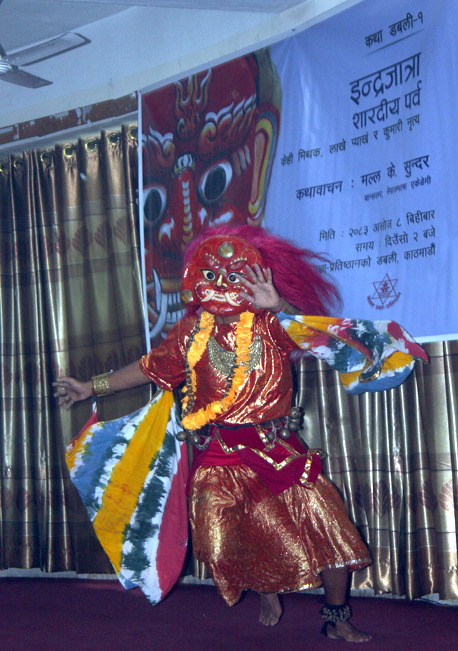
The story begins with Jung Bahadur’s journey to Britain. The story progresses like this ‘… The ship moving forward in the middle of the ocean shook. It shook violently. It was caught in the grip of a fierce sea storm. There were many people on the ship. Nepal's Prime Minister Jange, his brothers Jagat Shamsher, Dhir Shamsher and fourteen other high-ranking officials, eleven servants too. Everyone lost consciousness. The dream of reaching England was disappearing into the ocean waters. Everyone lost hope of life. No one could do anything. The Nepalese were shocked by the thought of the last moment. A Newar native of Kathmandu was also on the same journey. Subba Siddhiman Rajbhandari. At that moment, he lit a lamp and burned incense, scattered Aksheta everywhere. Then he folded his hands and closed his eyes. For a while, he called out in his own voice, in his own rhythm, in his own language - Hey Aju! Raksha Yana Bijyahun! - (Oh Lord! Protect me!) Immediately, the bells began to ring so that everyone on the ship could hear them. This made the others even more afraid. Those who were sitting there, huddled together. It was as if everyone's breath had stopped. But Siddhiman was stunned, he confidently announced - 'Come on, there is no need to be afraid now, nothing will happen. If you are confident, you will be fine.' Without saying anything, the ship that was shaking uncontrollably started to return to its own rhythm. It slowly started moving forward at its own pace and pace. Everyone became calm. Among them, the happiest person was Janga Bahadur. The deity whom Subba Siddhiman had faithfully worshipped from across the seven seas for salvation was Majipa Lakhe! He himself lived inside the courtyard of Jaisideval, Lakhe Nani. Next to his residence is the temple/place of worship of Majipa Lakhe. ...''
When faced with disaster abroad, Newars do not call on just any deity. Newars are usually associated with one or the other cultural geography. For example, the people of Kirtipur region call on Baghbhairav, while those of Khokana call on Sikali Maa. And, who is this Majipa Lakhe? The story includes many customs and influences, including her love story. Majipa Lakhe's story is not limited to this, stories of other Lakhe's stories can also be heard in abundance in Kathmandu.
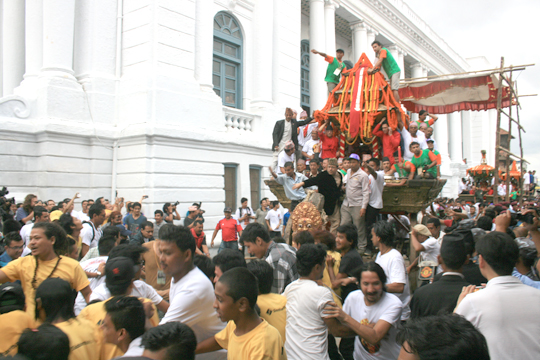
That's all Indrajatra, the main attraction is the chariot procession of Kumari. How is the story of Indrajatra made without mentioning Kumari? Many cultural elements of the festival are taken out only from the Kumari's house in Basantapur, in the Hanumandhoka Palace complex in Kathmandu, this custom is not found anywhere else. This chariot procession was so widely publicized that it became synonymous with Indrajatra. And, outside Nepal, Nepalese immigrants call Kumari's chariot procession Indrajatra only one.
While telling the story of Kumari, Malla K. Sundar brings up the story of another demon. That demon and a girl fall in love. The girl is the daughter of the Ashtamaturka clan. Listening to her mother's words, the daughter kills her lover Lakhe to protect the country and vows not to marry for the rest of her life, and becomes famous as the adorable goddess Kumari. Some other storytellers equate this Kumari of Basantapur with the maidens of the Ashtamātri clan. If we delve into the cultural history of this Kumari, she is neither a maiden nor the daughter of a maiden. The stories are intertwined in such a way that they confuse us. What can we say about other Kumaris in and around Kathmandu who are similar to the Kumari of Basantapur? In fact, they are female powers or ajimas who protect the neighborhood. The Kumari of Basantapur is also one such ajima. The locals also call her Dhamān. As new stories are added, it is natural for new stories to be created.
There is no fixed method of how to celebrate Yaya. It varies from place to place. Let's talk about Kathmandu, no one has to decide who will take or give what responsibility, various components are spontaneously activated from a certain time and place. This is what living culture is all about. All these cultural components were not designed at the same time and at the same time. Yaya has developed in the cultural history of Kathmandu for at least three thousand years, and during the development, some new components were added and some were closed. Each component has its own story. The story is also different from story to story. In the process of analyzing these components and the remains of the components, one must dive into those stories and find history. The story itself is not history.
The story of Indra Jatra narrated in 'Katha Dabili-1' is not the entire story. Rather, it can be said that Malla K. Sundar narrated a few of the many and as much as time allowed. In the case of different stories from story to story, these are only the stories narrated by the storyteller. It is not mandatory that the story told in this way should be like this. The listener can cut out something that he does not understand while retelling it. He can also add something to make the story heard more interesting. And it is found that stories are being created here in a ritual way, and the additions made in this way are also the subject of history study. The stories heard in the story hall do not only tell history, because the storyteller has come to tell the story, the listeners have come to listen to the story, not to listen and tell history. The storyteller explains, “Yenya (Indrajatra) is an intangible heritage for the students. But for the concerned indigenous community, it is a living culture and social faith.”
This story reading program organized by the Department of Poetry, Culture and Digitization of Nepal Academy has also been done with the aim of digitally archiving it for future generations. This is the first series, even if such a series is brought only from Newar society, it will be thousands of thousands. Nepal is not just about Newar people, if you bring them from all over Nepal, you will create millions of chains, you just have to make them.

More from Basanta Maharjan


Comments (0)
No comments yet
Be the first to comment!
Write a Comment