
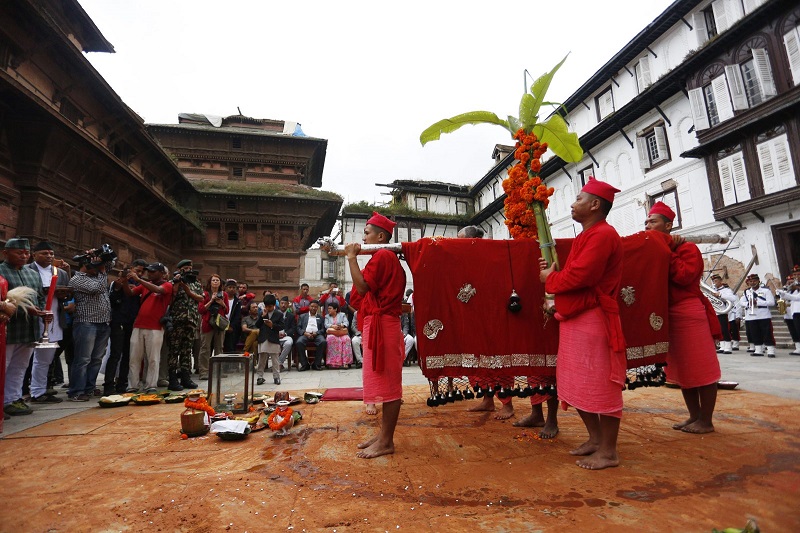

Who wouldn't be surprised when people carrying swords in their hands emerge from the Lion Gate of Hanuman Dhoka at night as if they were going to kill someone, that too when the entire country is immersed in the atmosphere of Dashain. This is a special glimpse of Dashain celebrated at Hanuman Dhoka Durbar, called ‘Payah’ in the local language and known as Khadga Siddhi.
Local Newars say – ‘Dashain may be the worship of power for others, but for us it is not only the worship of power but also the worship to attain power and this is achieved through Tantric practice. A good example of this is ‘Payah’ which comes out as Khadga Siddhi. Therefore, this is not only Dashain, but also Mohini.’
Payah comes out on the day of Dashami. Payah or Khadga Siddhi is the act of completing the worship according to Tantric methods and leaving carrying a powerful sword. It is believed that this power must be obtained in Dashain. The justification for celebrating Dashain is to attain Khadga Siddhi, for the Newars. Although the indigenous Newars of Kathmandu have a tradition of taking swordsmanship from house to house, those who cannot celebrate Dashain at home for various reasons are also taken out in this way so that they do not lose that power.
Earlier, military training was conducted for young men in various places, but it is said that it was stopped during the time of Jung Bahadur Rana. Why this military training, which was prevalent since the Malla period or the Lichchhavi period, was stopped during the time of Jung Bahadur is a subject of study. At that time, since the war materials used in the battlefield were kept in the Taleju temple, Paya: is also released from there during Dashain. It is not only released from Hanuman Dhoka. It is also released from Thamel, Asan, Indrachowk, Naradevi, Yatkha, Kilagal, etc. and from Bhaktapur and Patan. When those who have just gained power come out excitedly, every part of their body trembles and there is also the sound of ancient instruments played on the battlefield, which is not without some people who interpret it as meaning that they have come out for the battlefield. This meaning is given in some articles and books. The reason why the sword procession that comes out of Hanumandhoka is special is that there is also a person carrying the royal sword as a royal representative. Earlier, the Malla kings themselves used to participate in it. However, nowadays only representatives come.
The Dashain celebrated at Hanumandhoka is of a special type. In principle, the Dashain celebrated here is a larger version of the Dashain celebrated by the indigenous Newar community. The indigenous people worship completely according to the Tantric method during Dashain, which is different from the Vedic one. Although there are some ups and downs depending on the time and circumstances, the originality of hundreds of years ago can still be seen in the Dashain of Hanumandhoka, as the old rituals are still followed.
On the day of Ashwin Shukla Pratipada, it is considered that the formal preparation for Dashain is completed after the Ghatasthapana and Jamara are placed in the Dashain house located next to the main square of the Hanumandhoka palace. Earlier, the Jamara here was brought for use in the Narayanhiti palace. After Ghatasthapana, on the evening of Panchami, Pachali Bhairav is brought in front of Hanumandhoka. After this puja, which is performed in the presence of Kumari, a ram is sacrificed to Bhairav. After the sacrifice, Haraluch is offered for prasad. After the puja, Kumari is returned to her house.
On the seventh day, Phulpati is brought in. To bring in Phulpati, some people are sent from Hanumandhoka Durbar to Dhunibesi in Nuwakot. There, they sacrifice a goat to a tree with a characteristic vine and bring its leaves. In the same way, the Phulpati brought from Gorkha Durbar is mixed along the way, and when they reach Kathmandu, they reach Swayambhu and are reported to Hanumandhoka Durbar. Then, those who are ready to receive Phulpati reach Jamal on the northern bank of Ranipokhari and the Phulpati is carried on a doli with royal honors, covered with a jhallari umbrella, and taken to Hanumandhoka. At Nasalchowk, a goat is sacrificed after worshipping Phulpati according to the Tantric method and after worship, Phulpati is taken to Dashainghar. This method, which is done at Hanuman Dhoka, was added only during the Shah period.
On the day of Ashtami, Taleju Bhavani is brought from the Taleju temple to the main chowk after observing the auspicious time and a sword is installed along with the worship. During the night between Ashtami and Navami, a secret worship of Taleju Bhavani is performed at the main chowk all night long. In this worship that takes place all night long, one hundred and eight animals, including 54 rams and 54 goats, are sacrificed. The purpose of sacrificing in this way is to please Taleju Bhavani. A similar worship is performed on the day of Navami and one hundred and eight animals are sacrificed like the previous night. However, outsiders are not allowed to see this secret worship, which is performed only by the Taleju priests.
On Navami, the Taleju temple is open to the public. This temple, which is closed to the public at other times, is crowded from the morning for darshan. On the day of Navami, people enter through the Singha Dhoka, take off their shoes, climb the stairs of the Taleju temple, and perform pradakshina and descend. In this way, they exit Hanuman Dhoka through the main square. On the evening of Navami, the main Kumari, along with the other nine Kumaris, Bhairav and Ganesh, are brought into the Hanuman Dhoka and returned after the necessary prayers.
On Dashami, worship is also held at the Dashainghar during the day. The worship on this day is a bit longer. Earlier, after the worship, tika was taken as prasad to the Narayanhiti Durbar, but now this work is not done. The same worship is held at the Mulchowk. After all these works, finally, at ten or eleven o'clock at night, after removing the sword or foot, they go through the Kumari Ghar to the Singha Sattal and go to the Pyapal, Kam

More from Basanta Maharjan




Comments (0)
No comments yet
Be the first to comment!
Write a Comment