
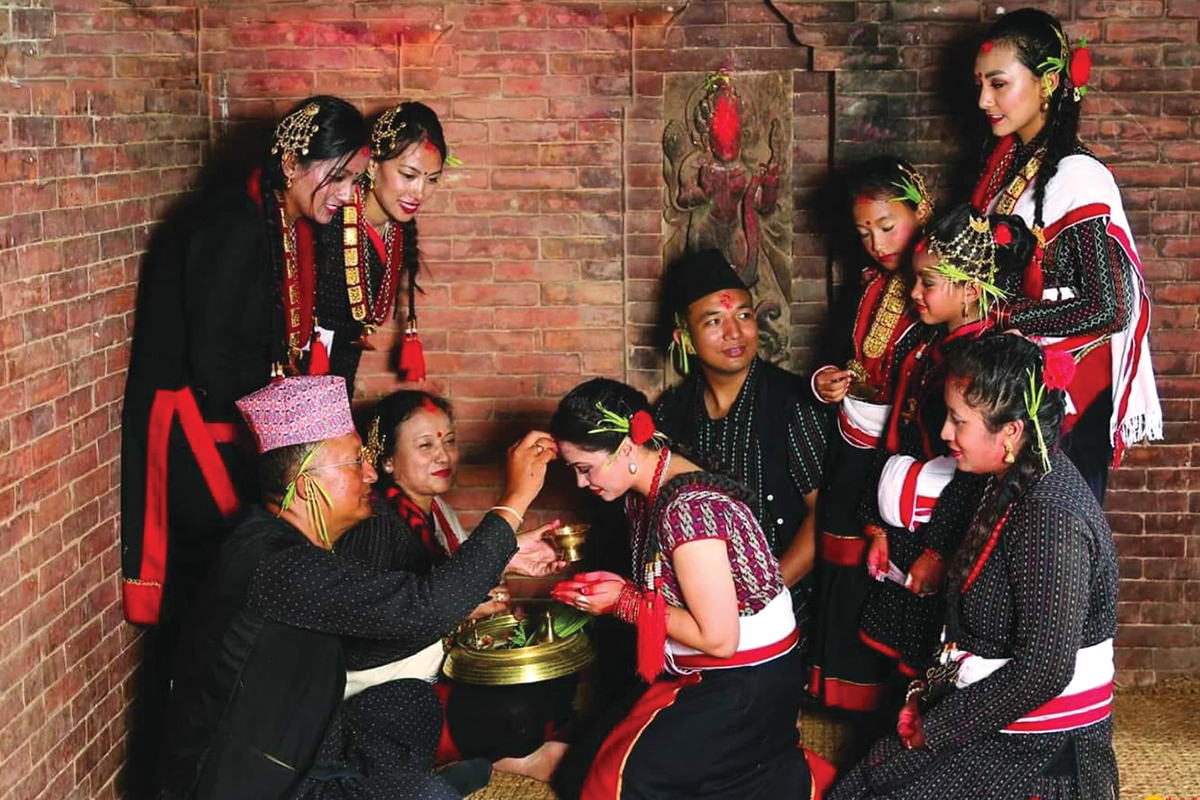
Dashain is a festival celebrated by various communities in Nepal and India from the first day of Ashwin Shukla to the full moon. In India, this festival, known as Dussehra, is celebrated as the victory of Rama over Ravana. Similarly, Durga Puja is organized in various places to celebrate the victory of Goddess Durga over Mahishasura. In Nepal, this event is celebrated with different rituals and traditions under the name Dashain.
In some societies, including Tharu, Kubindo is cut on Dashain. In the Rai-Limbu society of the east, it is also celebrated with tika and food. There is no specific ritual for celebrating Dashain in these communities. They say that Dashain is not their traditional festival, but was imposed later by the ruler and that they started celebrating it only because the elders learned from the ruler. In the Chepang society, Bhimsen is worshipped during Dashain.
In the Newar society, a festival called ‘Mohani’ is celebrated at the same time. There is also a debate about whether Dashain and Mohini are the same festival or different. However, when analyzing the debate between Dashain and Mohini, different facts of cultural development are found.
According to Kulchandra Koirala, author of the book Cultural Festivals of Nepal, it is not possible to say for sure when the importance of Dashain began. There is no mention of Bhagwati Durga in Vedic literature, only the existence of goddesses like Vani (speech) and Aditi, Usha etc. The Khilsukta of the Rigveda describes the characteristics of Shakti in the form of Lakshmi. However, it is not impossible to find hints indicating the importance of the goddess in the form of Shakti in Vedic texts.
Koirala has written, ‘Some later Puranas have mentioned the story of Lord Ramchandra killing the enemy Ravana, who conquered the three worlds, by observing the Dashain fast and worshipping Durga. However, historical researchers do not quite agree with the story of the Purana. In the Mahabharata, the special features of Durga are known from the praises given by King Yudhishthira during his secret life and from the context of some other festivals, but she is not as dominant as Shiva and Vishnu….’
Koirala estimates that the tradition of worshipping Goddess Durga during Ashwin Shukla Navratri began in the early part of the Christian era. The mention of the Mauryan army in the Chandi recited during Dashain makes it clear that it developed in India only after the fall of the Mauryan dynasty. In Indian history, Buddhism received protection during the Mauryan period, while the last Mauryan emperor, Brihadratha, was killed and a new dynasty was started by the general Pushyamitra Sunga in 187 BC. Based on this, Koirala's estimate seems correct.
Dussehra does not hold much importance in the Indian Hindu community. Although there is a mass celebration of burning the effigy of Ravana and the immersion of the idol after Durga Puja, it is not celebrated in every household like in Nepal. In Nepal, Dashain has a special influence in the mid-hilly region.
In the Newar civilization, the process of making statues of mother goddesses has been found to have started in the first century BC. Among these, the statues of Gajalakshmi in Chyasal Tol of Patan, Srilakshmi in Handigaun, and Kumari, Vaishnavi, and Varahi in Balkhu are notable. The Mahishamardini statue found in Handigaun is believed to be from the third century BC. Although the statues of mother goddess were made during the Lichchhavi period, the development of the Shakta sect took place in the Middle Ages. There is no indication of the Dashain festival during the Lichchhavi period.
There is diversity within the Newar people as well in the context of the Mohani festival. It seems that Mohani has become a grand cultural festival by combining various aspects at different times.
Mohini begins with ‘Nala Swanegu’ on the morning of the Ashwin Shukla Pratipada. ‘Nala Swanegu’ in Nepali is similar to placing a jamara. But in the eyes of Vanaspati, ‘Nala Swanegu’ and Jamara are the same, but they are culturally different. It is not clear whether ‘Nala Swan’ has been a tradition since the beginning of Mohini or it was introduced from somewhere else. Or whether Jamara has become popular in non-Newar society in imitation of ‘Nala Swan’ or there is something else, is a subject of study. Although the originality of ‘Nala Swan’ or ‘Jamara’ during Mohini festival has not been established, it has now become mandatory. Other communities also perform Ghatasthapana by placing a jamara at this time. Ghatasthapana in Mohini is not a Newar tradition, but Ghatasthapana has also entered Newar society.
The context of Vijayadashami being celebrated because of Rama's victory over Ravana is not connected to Newar society. The context of Durga Bhavani is also assumed to be connected to the Mohani festival only later from cultural studies. The practice of placing Phulpati on Saptami is also found only in the Malla royal court, nobles and a limited class in the medieval period, not among the common people. The Newar common people saw Phulpati only after Prithvi Narayan Shah conquered the Kathmandu Valley. Since then, Phulpati brought from Gorkha was also placed in the Agam house behind the Umamaheshwor temple in Kwacho, Kirtipur. Along with this, a Magar was also brought from Gorkha and kept there. However, since he had no role in the temple, it is clear that the practice of Phulpati was not prevalent among the general public before that.
There is no special ritual on the night of Dashain Ashtami. However, on that day, ‘Kuchibhvay’ is a must-eat in Newar society. Although this is usually a feast that is eaten by only the members of the clan, its rituals and symbols have a Tantric meaning. Perhaps this is a preparation for ‘Syakutyaku’ to be held the next day on the Navami day. Syakutyaku is the act of worshipping and offering sacrifices in a room where ‘Nala Swan’ (Jamara) is kept.
In the process, weapons and tools are also worshipped. The main object worshipped at this time is the ‘Thayapi’, a vessel used to keep jhandraksi. It is considered a symbol of Aju – Ajima, i.e. ancestors. Along with this, a special puja is performed and a lamp is lit to ‘set fire’ saying ‘Mohani Phayegu’. Durga Bhavani is worshipped along with other gods and goddesses. However, there is no connection between Durga and Buddhist Newars. That is, the worship of Durga in Mohani is an external cultural influence.
The ninth day’s ritual is ‘Shaktisadhana’. The next day, on the Dashami day, ‘Chalam’ is performed by Shaktisadhana.

More from Basanta Maharjan




Comments (1)
Write a Comment