
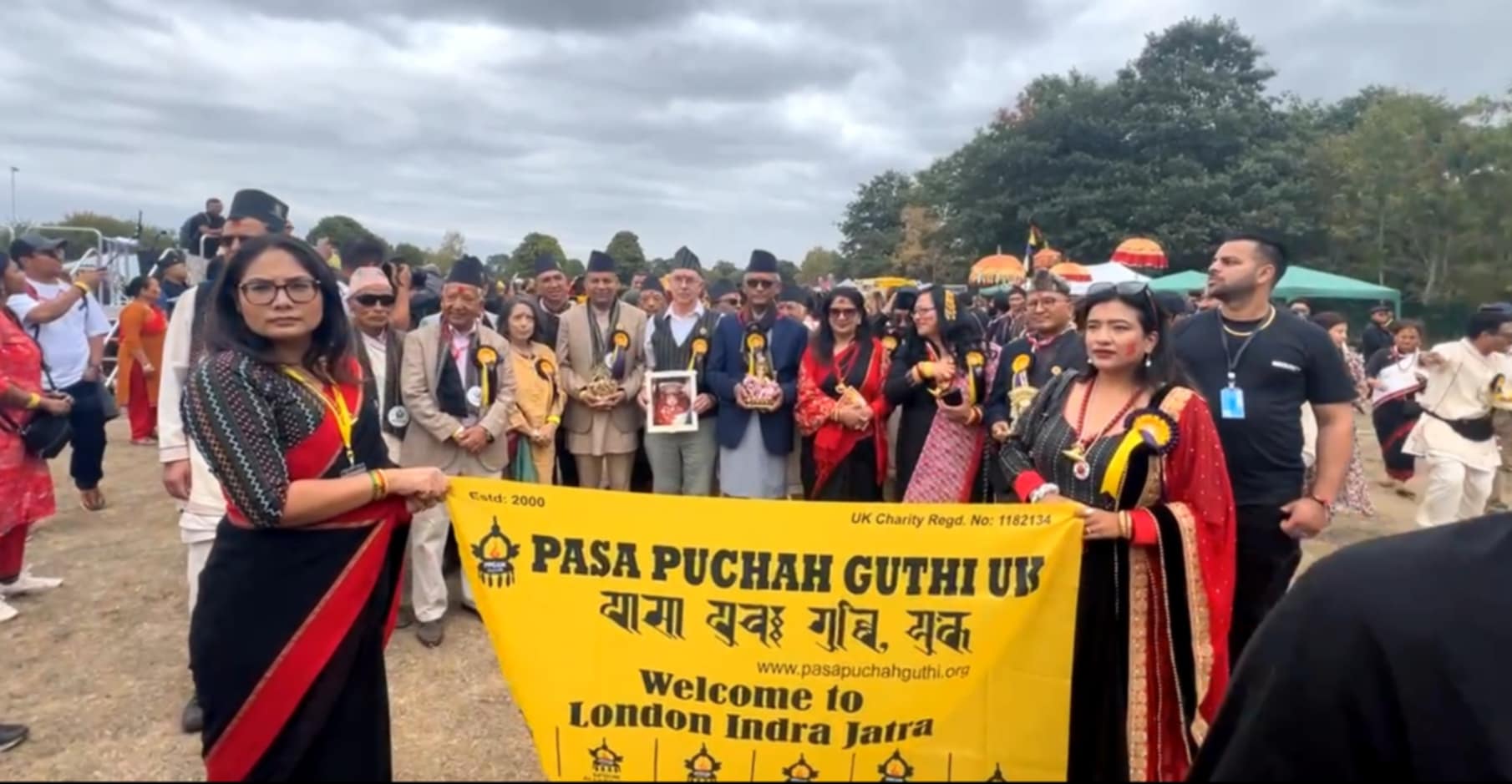
Those who are aware of Newar society or are interested in its pressing problems are not unaware of the slogan 'Bhasha Mwasa Jati Mwai'. This slogan translates to, as long as the language lives, the nation remains. This slogan is often heard in programs on language, literature and culture. In fact, banners with this slogan are hung at some program venues. In addition, the name of the great poet Siddhidas is also mentioned along with this slogan. That is, this idea or concept was expressed by the great poet Siddhidas Amatya and it was used as a slogan by the Newar society.
Indeed, does the nation remain if the language lives? This is a big question. It tries to show the relationship between language and the existence and non-existence of any nation. But this has not been the subject of research. Language is dynamic. The rise and fall of languages occur for various reasons. The development and destruction of different nations also occur for various reasons. These are two different issues, but in Newar society, they are seen as concerned with the same meaning.
Some Newar who present their identity as Newar do not know their own language. Not knowing the language does not mean that they are not Newar. Even if those Newar who are part of the Newar culture do not know the language, they are proud to be Newar. They want to learn. Or they cannot be taken otherwise. In this sense, the relationship between language and ethnicity does not match the slogan used by Newar activists who work for the protection and promotion of the Newar language and ethnicity. Moreover, the message in this slogan is not the result of any research. It is just an emotion of a language lover.
Newar is a civilization. It has many aspects. It also has its own language, which is informally called 'Newar language' and formally called 'Nepal language'. Even though some people say ‘Newari’ or ‘Nyar Kura’, the intention behind objecting to the words Newari and Nyar is to avoid tarnishing the name. It can be understood that some people object to the use of ‘Newari’ and ‘Nyar’ when they are trying to disparage or denigrate the Newar community. Not realizing this, some ignorant Newars themselves use the word ‘Newari’ but do not use the word ‘Nyar’. Words like Newari and Nyar have no historical basis and have only recently started being used by non-Newar communities. When Newar themselves have to take its name from their own language, they say ‘Newa Bhay’. This is the original meaning of the word ‘Newar Bhasha’. Linguistically, it means ‘Nepal Bhasha’.
Newa Bhay, Newar Bhasha or Nepal Bhasha, belongs to the Tibeto-Burmese language family. Some have called it a language that developed in the Kathmandu Valley in the eleventh or twelfth centuries, but this is the study or expression of Hachuwa. The creation of written literature cannot be called the birth of the language.
The main historical source of ancient Nepal is the Lichchhabi inscriptions. About two and a half hundred inscriptions have been found. What we know from them is that the trade, business, politics, religious philosophy, social life and education of the then Nepali society had become very prosperous. The records are in Sanskrit, but the names of various offices and institutions are in non-Sanskrit languages. This means that a certain civilization had emerged here even before the prevalence of Sanskrit and the names of offices and institutions were kept in the local language. When records were kept in Sanskrit, those old names were not translated. Similarly, those inscriptions contain more than two and a half hundred non-Sanskrit words that refer to specific places, canals, rivers, mountains, etc. Those words are still in use in Newar society today. Some people say that the non-Sanskrit words found in the Sanskrit inscriptions of the Lichchhavi period are from the Kirat language, but those who say so lack linguistic knowledge. The non-Sanskrit words found in the Sanskrit inscriptions of the Lichchhavi period are also found in other languages. It should be noted that there are many languages within a language family. Kirat is also a language under the Tibeto-Burman language family. Not only Kirat, but also Gurung, Magar, Tibetan, Japanese, etc., are found to be similar to Newar. Is it surprising that some words are similar since they are languages of the same family? At one time in history, the Newar society also came into contact with the Kirat community, but it is also found that the Kirat community merged with the Newar. Newar is not a separate civilization, but it is found that various castes, languages, religions, and cultures have merged and developed while maintaining its originality. If we talk about the language itself, although it belongs to the Tibeto-Burmese language family, it has incorporated a large number of words from the Indian language. This is why in some cases it is also found that it is a Indo-European language. Therefore, the non-Sanskrit words used in the Sanskrit inscriptions of the Lichchhavi period are from the Newar language and that language is still in use today.
It is understood that even though inscriptions were made in Sanskrit during the Lichchhavi period, the Newar language was used in public life. In the medieval period, the custom came to use Sanskrit in the initial part of the inscriptions and later Newar language. Moreover, the vernacular language was used by saying ‘Ath: Nepalbhasha likhte’. What is more interesting is that ‘Ath: Desh Bhasha lekhte’ is also found, meaning that it was recognized as the national language at that time. Maithili language was also used in society. At that time, pure Newar language, pure Maithili language, and both Newar and Maithili languages were used in literary creation. This is a picture of medieval Nepal.

More from Basanta Maharjan





Comments (0)
No comments yet
Be the first to comment!
Write a Comment