
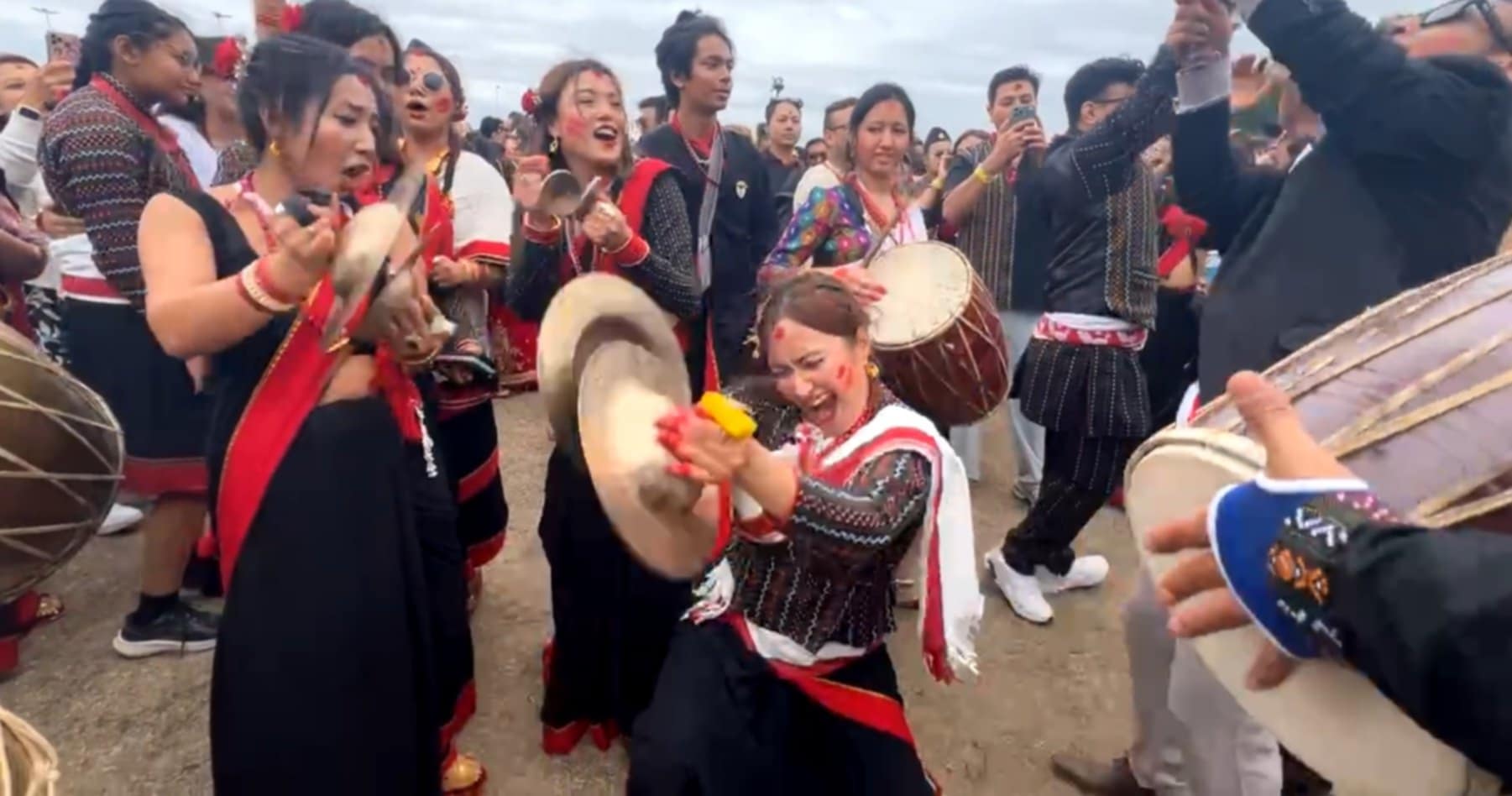
It is common to hear the Dhime Baja playing in any crowded or ordinary place in Kathmandu. It is a type of folk instrument that is often played during religious and cultural festivals. Even if only one or two Dhimes are played, the sound of the drums resonates as if they were played by a human. Although other instruments are becoming extinct due to the influence of foreign instruments, it seems to be gaining popularity and becoming widespread.
Dhime is a very popular instrument in the life of Kathmandu, which has originally had religious and cultural significance since ancient times. However, perhaps due to its popularity, it is now being used for occasions other than cultural ones, which is wrong from a historical and religious point of view.
It is possible that a type of Dhime Baja has taken the form of a type of Dhime Baja from the instruments used to scare and scare animals in the wild era. It is played by carving the inside of the trunk of the tree, wrapping it with animal skin on both sides, and holding it tightly with one hand and the other like small pliers. After the Dhime, it was probably used to show that there were many soldiers with them when there was an attack. This multi-purpose instrument was not only taken to the temple but also used to dance to its tune in the absence of other instruments. Since this instrument was originally played by the Jyapu community, it is also living proof that the Jyapu tribe is the indigenous people of the valley.
The shape of the Dhime is similar to the instruments of many indigenous peoples of the world, including the Chhabrud and Dhol. The similarity of the shape and structure of the Dhime with the instruments of the indigenous peoples of Africa is not just a coincidence, but it can be said that its emergence was due to the same nature at the same time and place. However, some differences in their structure and differences in tone are changes that have occurred with the development of time. In terms of development, the dhunya that is played with the dhime is not from the early days of the dhime. The use of the dhunya in war or victory celebrations is a Vedic culture, and the work of introducing Vedic culture to Nepal and integrating it into the local culture was done by the Lichchhavi, Vrijji, Koliya, etc. and then by other communities in ancient times. It is very possible that the dhunya developed into the dhunya when the dhunya was used in the dhime.
Depending on the place, other instruments are played as auxiliary instruments of the dhime. The bhusya is mainly played with the dhime, but in Bhaktapur, not only the bhusya but also the sichhya is played together. Similarly, the kaypi or tainain is also played somewhere, and in Bhaktapur, the pwanga is played with the gu thals and in various toles in Kathmandu, the ma (moo) dhime is played with the dhime, and in the Bisket Jatra of Thimi, the muhali is played with the dhime. There are two types of dhime. The first or main dhime is called Ma (Moo) dhime which is of a large size. Similarly, the other small dhime is called Yalepah.
There is a strict rule that the dhime should not be taught to anyone who gets it or to anyone who gets it like other instruments. Men of the Jyapu caste who want to learn this instrument are considered eligible for training only when they have completed the vaṇalaṇtayegu (waṇalaṇ Dhime worship should be done according to Tantric methods. Since women have to pay full attention to the list of things to do during Dhime, it is understandable that they are trying to keep them away from this instrument as much as possible, as women may have irregular menstruation. Even a decade ago, women were not allowed to play Dhime, but today women can be seen playing Dhime in public in a fully cultural environment, dressed in haku patasi, and it looks attractive.
The world community should be indebted to the indigenous Jyapu community of the valley, who originated the Dhime instrument in the wild age of human civilization and have kept it alive as a racial tradition and culture by adjusting to time and civilization. Although Dhime seems to be only for the Jyapu community, from the point of view of civilization, it is an invaluable treasure of the world community. Even so, it is not limited to the Jyapu community today.

More from Basanta Maharjan





Comments (0)
No comments yet
Be the first to comment!
Write a Comment