
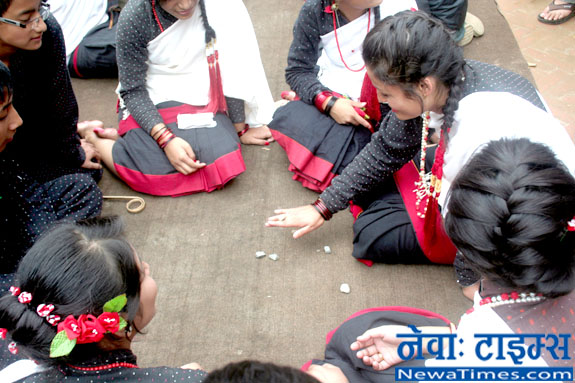
Today, every activity and behavior of society has developed from a gender perspective and the idea of advocating gender equality has developed. This is a topic that needs to be looked at in detail. One aspect of this is the role of sons and daughters. In some societies, no special importance is given to daughters born by themselves, while in some societies, there is diversity in the matter of roles.
The study of the role of daughters in a society is an important topic of sociology. This article briefly discusses the role of daughters in Newar society, which will open the door to detailed study. In addition, it will also help in understanding Newar society.
When discussing the structure of Nepali society, we usually include Newar in the names of more than a hundred ethnic communities such as Brahmins, Kshetri, Tamang, Magar, Gurung, Tharu, etc., but not all Newar are of the same race, same religion, and same historical background. Newar refers to a diverse ethnic group that entered the Nepal Valley (present-day Kathmandu) at various times in history and made this land their home. They became known as Newar after leaving behind the knowledge they brought with them and becoming immersed in the civilization here.
The name of this land is 'Nepal', and the evidence that the people living in this land, that is, the people of Nepal, were addressed as 'Nepal' as a community-based word is mentioned in ancient historical sources. This community-based word 'Nepal' has now become 'Newar'. Since it was a civilization formed through the blending of various beliefs, beliefs, customs, and knowledge, it is also called Newar culture or Newar civilization. The question of how Newar civilization viewed daughters and their role is equally interesting.
In Newar society, there is no discriminatory view of whether a son or a daughter is born. The remains of the fact that prehistoric Newar society was matriarchal can still be seen today. Later developed society also seems to have followed the same trend.
The ritual ‘Ihi’ performed on daughters in this society is not from prehistoric times. At one time, when child marriage was widespread in neighboring India, especially in Hindu society, Newar society did not like it. The supporters of child marriage prepared scriptures and books, arguing many arguments about its justification or usefulness. Since there was no way to stop that influence, Newar society very cleverly developed the ritual of performing child marriage, but not with a human being but with a symbol of a god. This ritual is called ‘Ihi’.
‘Ihi’ is usually performed when a girl reaches the age of seven. The child marriage called ‘Ihi’ is performed not with a human being but with a god and since the god is immortal, the social belief that Newar girls should never become widows also developed. Even if a woman marries a man after reaching adulthood, it is considered only as a practical life. In this society, women can easily get a divorce (divorce) by simply returning three betel nuts to their husbands. To some extent, it is not even necessary to give three betel nuts in person; they can even leave with them on their pillow. Or, even if three betel nuts are thrown from afar at the body of their husband who is being burned on the pyre, the divorce is socially recognized. There is no need to grieve. They can remarry. This right that women have acquired in Newar society is probably a remnant of prehistoric Newar society.
There is a custom of performing ‘baraha’ during or immediately after menstruation. Baraha is performed to show that the girl has matured and is ready to pay attention to the necessary things for the coming days. During this process, the older woman teaches the daughter how to live her future life by involving her in certain rituals.
In Newar society, a daughter also gets married after reaching adulthood. The goods given to a married daughter as dowry are called ‘Kwas:’. The root word for ‘Kwas:’ is ‘Kwasal’. The etymology of the word ‘Kwasal’ remains to be considered. Kwas: and Koseli are different things, but it can be compared to the word dowry. In some societies, after raising a son and getting married, the son's parents or the son himself ask for dowry from the daughter's family. The act of asking for dowry is also forced. In some cases, it creates problems in the daughter's family in such societies. This is why opposition to the dowry system has started in the relevant society.
In Newar society, there is no such thing. The utensils and other items given by the family and relatives are called 'Kwas:'. The bride's friends also keep them. In 'Kwas:', there is also a social norm that determines who will give which item based on the relationship. The items included in it include items that are essential for any family to maintain social, cultural and practical life. This is the daughter's gift.
The daughter herself does not use Kwas: immediately, but she gradually uses it when she becomes the head of the household. In a joint family, some items are used voluntarily when necessary. It is also found that it is used only for the purpose of one's room. Furniture such as beds, tables, etc. are used immediately in one's room. In some cases, two copies of the inventory of the goods received in the Qas are made, one copy is kept by the family and the other is delivered to the husband's house. The husband's house is protected by the inventory of the goods received according to that inventory.

More from Basanta Maharjan





Comments (0)
No comments yet
Be the first to comment!
Write a Comment