
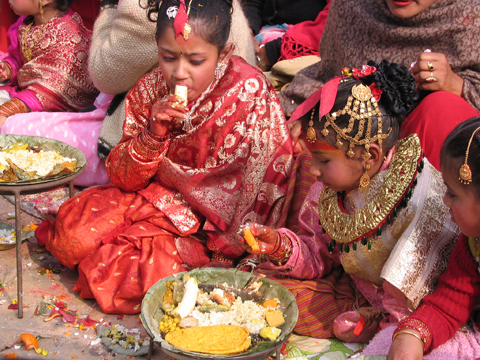
In society, a woman becomes a widow after the death of her husband and has to spend the rest of her life differently according to her own social norms. Hindu women are considered to be more oppressed by the concept of widowhood, but there is also a belief that even though they are Hindus, Newar women are never widows, they are always blessed throughout their lives, that too on the basis of Hindu values and norms. This belief has developed as a result of a culture adopted to prevent child marriage from entering their society. This culture is ‘Ihi’.
There is a tendency in Nepali and Indian societies to consider widowhood as a curse. Due to beliefs such as the belief that widows should not marry, millions of women in Nepal and India are living a hellish life, suffering from a sense of inferiority, inferior mentality, and distorted mindset. It is emphasized that widow marriage should be encouraged, considering the practice of widowhood as an exploitation of women. But in the Newar society, which believes that women never become widows, there is no word for the word widow in their language. That is why, in the context of this custom, Swayambhu Lal Shrestha praises it as a progressive step. Praising it, he considers it a matter of ethnic pride that despite the enactment of many laws, no law has been passed to destroy the concept of 'widow', but that there is no such concept in Newar society.
Although the word 'ihipa' is used today in the sense of marriage, 'ihi' is also found in old dictionaries to mean marriage. Girls are performed this ritual at the age of four to seven or eight. It is basically believed to be a marriage with Bel, which is a symbol of Lord Vishnu in Hinduism. For this reason, it is believed that since a Newar woman is married to Lord Vishnu, she will never become a widow. The belief that Lord Vishnu is immortal has also given strength to this belief among Hindus. According to the story, when Parvati asked for a boon that no Nepali should become a widow, Mahadev himself had told her that she would not have to become a widow if she married Bel, the symbol of Vishnu. But those who do not understand this are also found to mock Newar women at the time of their actual marriage as already married and the man as someone else's wife. There is also a tendency to not fully understand the knowledge of how the problems facing women in society were cleverly resolved.
On this subject, Sardar Iqwal Ali Shah writes – “If the husband of a Newar woman dies suddenly, the importance of her primary marriage to Bel becomes apparent. This shows that she has not become a widow and can remarry. She claims that she is not a widow because she married Bel when she was a child. This belief is found only in the Newar community in Nepal.”
The problem of child marriage is a hot topic in society. It is believed that the practice of child marriage has come about because it is written in some texts that a girl who has not yet menstruated should be given as a bride and that doing so will bring religious benefits to her parents. In societies where this belief exists, the practice of giving away a girl as a bridegroom was actually practiced, but this amazing custom was developed in the Newar community as an alternative to child marriage. According to Dilli Raman Regmi, there is no child marriage practice in Newar society. He writes in his book ‘Ancient Nepal’ – ‘‘But they have protected their women from becoming widows throughout their lives in accordance with the principle of divine or permanent wifehood.’’
There is no authentic record of when this practice began. This practice is not found in some sub-communities within the Newar, including the Gopalis. Why it is not found is a matter of research. But today, in the presence of other Newars, they also do the same for their daughters.
Despite the importance of marriage for married life in Newar society, the easy way to divorce is also in accordance with social norms and its right is vested in the women. According to this, a woman is considered to have divorced her husband by returning the betel nut to her husband. The act of returning two or four betel nuts bought from the market, which are considered to be the same as the betel nut received from her husband during marriage, and getting a divorce is possible not only while the husband is alive but also when he is on his deathbed, in a funeral procession or on the pyre, and after this, there is no need to change his mind. Based on this, there is a cultural belief that a woman is completely free to live a single life or marry someone else.
However, in the Newar society, with the increasing trend of forgetting their values and norms, widowhood is now gaining recognition. Women wear white clothes saying 'I am a widow' and live a single, solitary and neglected life without remarrying like non-Newars. But this can be considered as an external influence in Newar society. Even today, this is done as a matter of course in the name of tradition, but due to the influence or imitation of other societies, the concept of widowhood has also been allowed to flourish. Or it can also be said that the new generation is beginning to be surprised by the hidden secrets within it. As Hindu and Buddhist influences came into Newar society, they started forgetting their originalities or continued as relics even though they did not understand the meaning. It seems that the Newar society, which has a simple, easy and tribal lifestyle, cleverly adopted this practice only later to prevent the concept of child marriage and widowhood from entering as external influences increased.
There is no basic text that promotes gender discrimination in Newar society. Based on these things, it seems that the place of women in Newar society is equal to that of men. But such discrimination is not justified in addressing some of the inequalities that have been seen on various occasions.
(Source: Hasana Magazine, Year 6, Issue 48, 2068 B.S.)

More from Basanta Maharjan




Comments (0)
No comments yet
Be the first to comment!
Write a Comment