
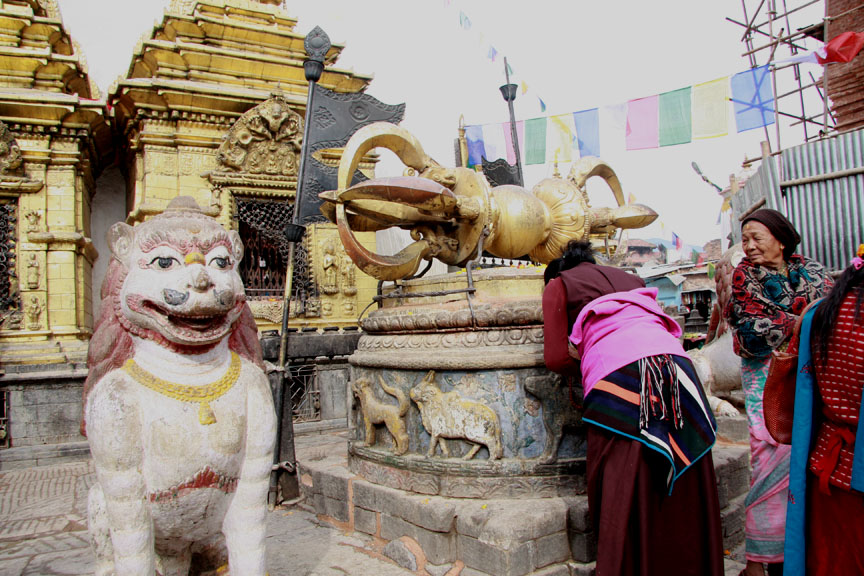
In the Kathmandu Valley and the Newar Buddhist community associated with it, there is a special splendor around the month of Shrawan. This month-long splendor is considered very important from a religious and cultural point of view. In this community, it is called ‘Gunla Parva’ or ‘Gunla Dharma’.
The month from the Shukla Pratipada of Shravan to the Shukla Pratipada of Bhadra is the tenth month according to the Nepal Sambat and is called ‘Gunla’. The word ‘Gun’ or ‘Gun’ is abbreviated to name the month and is called Gunla (Gunamahina), which is also used in a way that causes misinterpretation of the meaning when it is misspelled. Even in the same book and newspaper published in the Newar language itself, the word ‘Gunla’ and ‘Gunla’ are sometimes used. This shows that the difference between Shirbindu and Chandrabindu is not paid attention to. Similarly, it is also found that non-Newar society understands the male testicles as strange and considers them strange, understanding that both Shirbindu and Chandrabindu are not used. It is also found that some Newars themselves are confused because they cannot refute such a misconception. This is a lack of cultural interaction.
In Newar society, there are both Buddhist and Hindu followers, that is, during the Gunla period, there are not only Buddhist activities but also Hindu activities in abundance, but since Buddhists give special importance to it for an entire month, it has become synonymous with Buddhist culture.
The cultural life of Buddhists is not the same all over the world. Although the birth of Gautama Buddha, Bodhilabha (enlightenment) and Mahaparinirvana, three important events in life are considered to be celebrated on the day of Vaishakh Purnima, there is diversity in it all over the world. Some Buddhists in India, Sri Lanka and Nepal observe only one day of Vaishakh Purnima, while at other times they celebrate from Chaitra Purnima and conclude it with a grand celebration on Vaishakh Purnima. Similarly, Thai society also celebrates from Vaishakh Purnima to Jestha Purnima. In Tibetan tradition, they celebrate and worship with special devotion for a month or more, called ‘Sagadava’. On the same day of Vaishakh, the Newar society of Kathmandu Valley also has a traditional culture of celebrating ‘Swanya: Punhi’ in the name of Buddha. Like the Panchadan (Panjaran), Samyaka Parva, Dipankha Yatra, etc. prevalent in Newar Buddhist society, ‘Gunla Parva’ is also not found anywhere else except in the Newar Buddhist society of Kathmandu Valley. Therefore, it has succeeded in maintaining its own unique identity in the world Buddhist culture and should be considered as an original intangible heritage of Nepal.
On the day of the beginning of the Gunla festival, from early morning of the Shravan Shukla Pratipada, a very interesting sight can be seen as children, teenagers, young men and women and elders come out in groups from various places in Kathmandu with musical instruments and head towards the famous Swayambhu Mahachaitya. Those who come in this way especially come playing a musical instrument called Dha. The Buddhists of Kathmandu believe that this musical instrument was a very favorite instrument of Gautam Buddha and according to this belief, the Shakyas of Kapilvastu also believe that they brought it with them when they entered the Kathmandu Valley. Similarly, it is also seen that they come blowing the horn of a cow (shringabheri) like a musical instrument, saying 'Neku Puyegu'. This musical instrument is called 'Neku'. Nowadays, flutes and other band instruments have also started being used. Although only the ‘Dha:’ is specifically referred to as the Gunla instrument, it is also found that all the instruments used in this festival are referred to as Gunla instruments. It seems that a competition is organized to show how good the instrument of which group or village is. The activity of the new generation in the instrument is exciting. Not only this, the participants in the group go out reciting various Dharani Stotras, Prajnaparamita, etc. along with Nama Sangiti. They leave their village and reach Swayambhu through various Buddhist places and return after visiting many Buddhist places there and returning in a ritual manner.
This month-long circumambulation is also considered by Buddhists as a form of spiritual practice. Buddhists or instrument groups from different places participating in the Gunla festival do not always come to Swayambhu Mahachaitya. This is not a practical matter. That is, the Buddhists of Patan go to Bungmati in the south, the Buddhists of Bhaktapur go to Nala, the Buddhists of Banepa go to Namobuddha, and the Buddhists of Sankhu go to Gumbaha (Vajrayagini). Even in small settlements such as Kirtipur, during this period, the Buddhists go around the Buddhist sites such as Bahaha and Bahi (vihara), Stupa, Chibhaha in their respective areas. But the tradition of reaching Swayambhu on one day of the month that suits them has been followed till now. Swayambhu Mahachaitya is considered a center in the Buddhist tradition of the Kathmandu Valley. Newar Buddhists who have moved to districts outside the Kathmandu Valley and settled permanently have also been celebrating this festival according to their own traditions. Newar Buddhists are found living in some city markets including Pokhara, Tansen, Bhojpur, Dolakha, and they are leading a Buddhist cultural life in the tradition of Kathmandu. If the Lumbini region, the birthplace of Gautam Buddha, could also celebrate Gunla festival and conduct daily parikramas and other activities like in Kathmandu, this World Heritage Site could be made more lively.
The Gunla festival or Gunla Dharma is not only a religious and cultural festival, but it is also musical and entertaining. Since those who participate in it are inspired by religious feelings from the morning, a feeling of friendship and compassion arises in the mind. It also brings family happiness, peace and prosperity.

More from Basanta Maharjan




Comments (0)
No comments yet
Be the first to comment!
Write a Comment