

The sight of the monks coming from afar was seen. They were getting closer and closer.
At the forefront, I saw the monks Panjakara, along with Neeraj, and the other monks walking forward in a hurry. That time turned into a peaceful, serene and joyful atmosphere. The sight of the monks arriving was very beautiful. The faces of the monks were smiling, full of friendship and compassion. There was no fatigue or sadness. The message of awareness, consciousness, patience and peace was being revealed in every step of all the monks. The monks walking on the path of peace were teaching that there is power of peace in silence. As the monks approached, tears of reverence and respect began to flow from the eyes of the waiting people. I also felt that I was visiting a sacred place, where one becomes filled with reverence after reaching it.
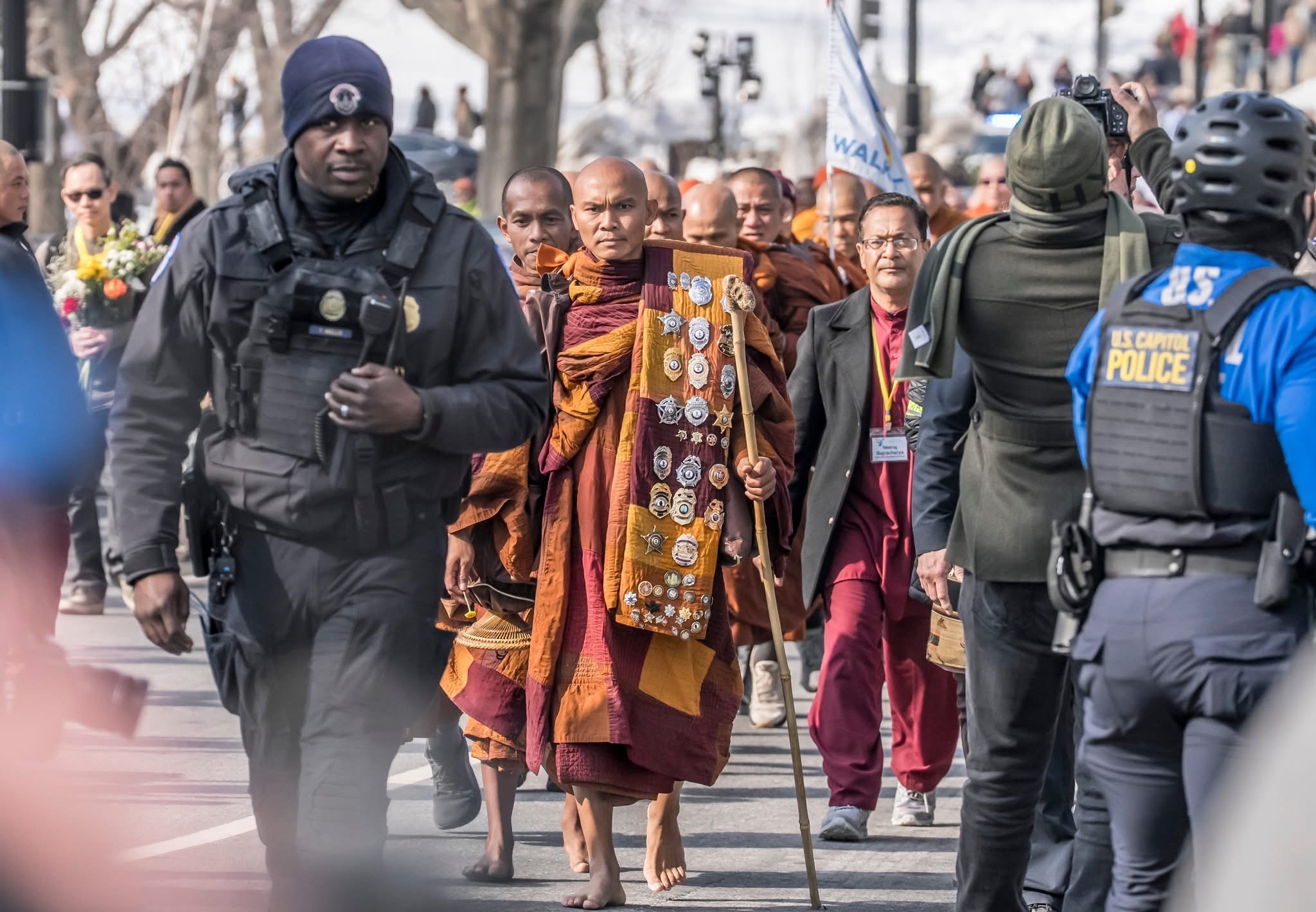
The Bhante Panjakara saw me from a distance, smiled at me. It seems that he was happy to see me and blessed me from a distance. I offered him food, and he accepted it. The story is about the 108th day of the walk, that morning there was an interaction program for students and teachers at the American University with the Bhantes. When the Bhantes finished the interaction program that morning and came to the church for food, thousands of people were waiting on both sides of the road to see the Bhantes. Rosie, Noreen and I reached the National Methodist Church early in the morning. We met Krishna there. We were also waiting in the front row with food to welcome us on the stairs leading to the church.
I am directly and indirectly involved in the peace walk. Initially, as we (Neeraj and I) thought, I participated in the final stage of the walk and the closing ceremony to be held in Washington, DC on February 10 and 11 to complete my side’s ‘Walk for Peace’. On February 10, we had an interfaith ceremony and unity walk at the National United Methodist Church in the morning, an interfaith ceremony and unity walk at the Washington Cathedral Church in the afternoon, and an interaction program with the students and teachers at George Washington University in the evening. After lunch, we walked for an hour and a half and reached the Washington National Cathedral for the interfaith ceremony. On the way, we met an opponent who had appeared in Georgia and was shouting with the same sign. Perhaps he had been following the Bhantes from Georgia. As the Bhantes approached, the man started shouting even louder. Then immediately traffic police and police cars were added. Bicycle and motorcycle traffic police also arrived. The Bhantes were surrounded by fences on both sides of the road and made to walk. This honor given to the Bhantes in America made my heart happy.
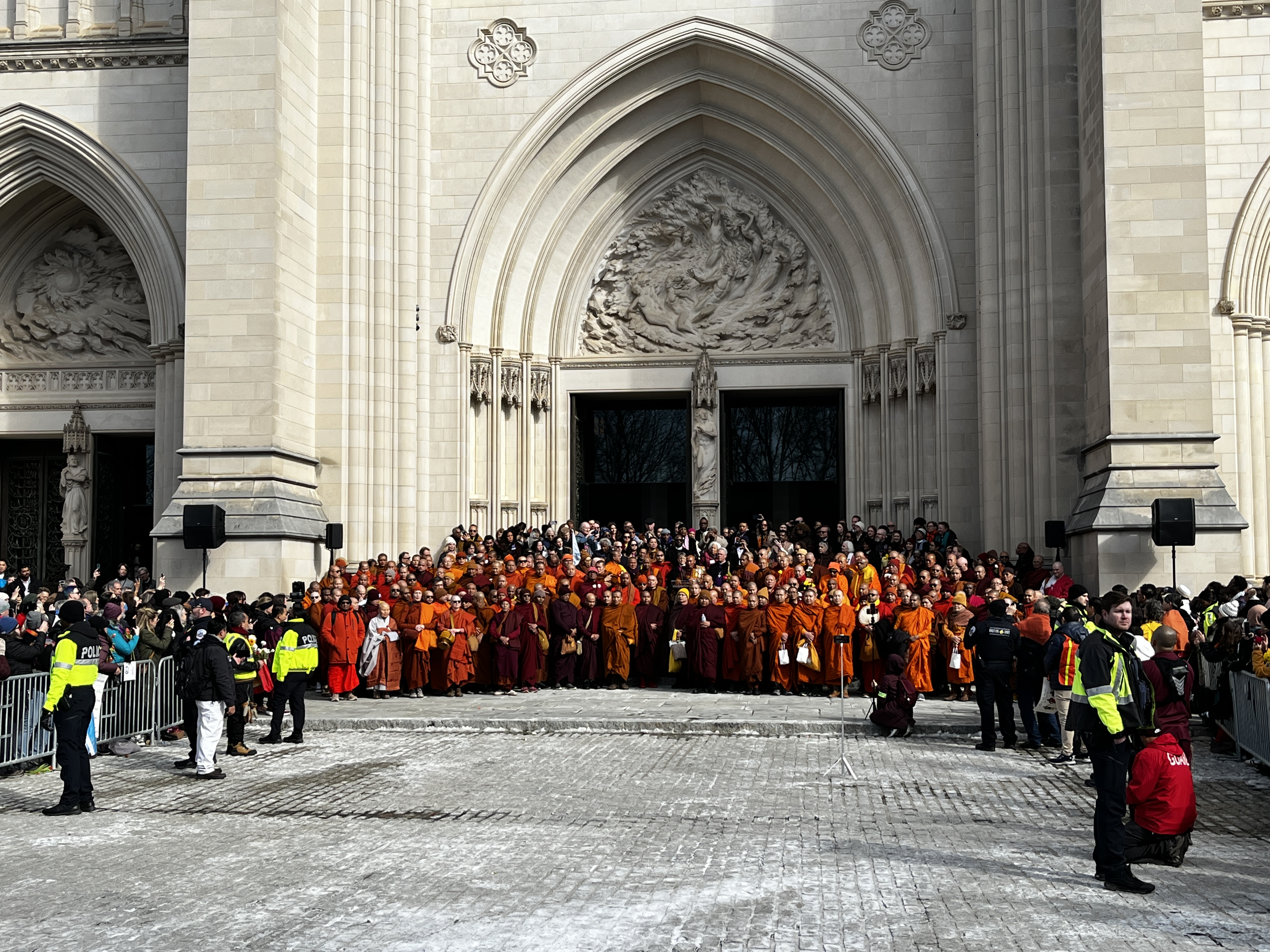
Many other new Bhantes had come for today's walk. Initially, 19 monks from the United States, Thailand, Vietnam, Laos, Myanmar, and France came to participate in this peace walk led by Bhikkhu Panthkara. This peace walk program was coordinated by Dr. Neeraj Bajracharya. After all the necessary preparations for this peace walk, the journey began on October 26, 2025, from the Hyeong Dao Vipassana Bhavana Center in Fort Worth. The peace walk passed through Austin, the capital of Texas, Louisiana, Mississippi, Alabama, Georgia, South Carolina, North Carolina, Virginia, Maryland, and ended in Washington, D.C., the capital of the United States. At the beginning of this walk of the monks, people gradually came to understand, agreed, and then the number of people who accepted and agreed to this walk reached thousands. Thousands walked with the monks. Police departments, churches, temples, and families welcomed the monks. Many cities also issued peace march manifestos and letters of appreciation. Strangers became supporters. Observers became participants. Step by step, barefoot and steady, the monks crossed state lines, cities, highways, snow, wind, and rain. By the time they reached Washington, D.C., the peace march had received worldwide publicity, and the number of people who came to participate in the event had reached into the millions. Millions watched online. There was news coverage in many media outlets. Almost all social media outlets had already taken the peace march door-to-door. So far, monks from many places have come to join the march in some small way. The Washington National Cathedral Interfaith Ceremony was a peace assembly and interfaith ceremony. The interfaith ceremony there brought together thousands of diverse participants and religious leaders in a shared dedication to peace, harmony, and compassion.
At the ceremony, Venerable Bhikkhu Khima expressed his heartfelt gratitude for organizing the event and thanked the Washington National Cathedral Church. He said that a place of religious significance should open its doors to other religions and lead to new hope with an open heart.
Then, addressing the crowd, Bhante Panjnakara said, “Behind me now, we have different religious leaders, and in front of you all, you can see all religious leaders standing together with the single ambition of peace. This is the first time for me that we are walking together for a peace march. We are walking together on this path to find peace for ourselves, to share our nation and the world. For me, this is a moment that I will remember for the rest of my life. And, I hope you will do the same.”
Other monks also gave speeches at the ceremony.
After the program outside the cathedral, the monks were welcomed inside the church by the priests, deans, bishops and other executive figures of the church. Only monks and a few representatives were allowed to enter the church. Since we had a ticket to represent us, Krishna and I were able to go inside. The priest and other members of the church highlighted that different religions and followers have their own importance and place in this society. There was also interaction between followers of different religions. There, the monk Panthakkara was asked, what do you think about Christianity? The monk said, “I respect all religions. I do not speak against any religion. Whatever others say about Buddhism, it does not disturb us. For us, we practice and respect our religion. For me, all religions teach people how to live a good life, how to be good people, how to support the society and the country we live in. Churches, temples and other places of worship teach the next generation to be better people. I do not have the knowledge to speak on behalf of other religions. But I share a message, we may have different backgrounds, beliefs and religions, but in all our practices we also have one common religion which is the religion of love, kindness, compassion and peace. I respect all religions. There is no need for division. The world should be united like this. With deep gratitude, I express my heartfelt thanks to the Bishops and the Christians, Muslims, Hindus, Jews, Buddhists, our teachers and their teachers, Sikhs, Baha'is, indigenous, interfaith and spiritual leaders who accepted our call and joined us at the National Cathedral at short notice. You opened your heart and made this sacred place feel like home.”
In response to another question, Bhante Bodhi addressed the crowd, saying, “Generations past stood against war for civil rights. Today, it feels like a time of fear has come again in this world, but the answer is not more shouting, not more anger, not more division. The answer is the quiet courage to walk for peace, one step at a time. 108 days is not just a number, 108 days represents the human struggles we all carry within us, and with each step the Bhantes take, those struggles feel lighter, softer, and freer. This walk is never about distance. The Bhantes are walking not to prove any strength but to practice peace. Perhaps that is the real teaching, that peace is not what we call it.”
The teaching the Bhantes are trying to impart is the transformation of peace, one step at a time, one heart at a time, one breath at a time. This walk was about the duty of following the right path in the face of hurt, storm, and criticism.
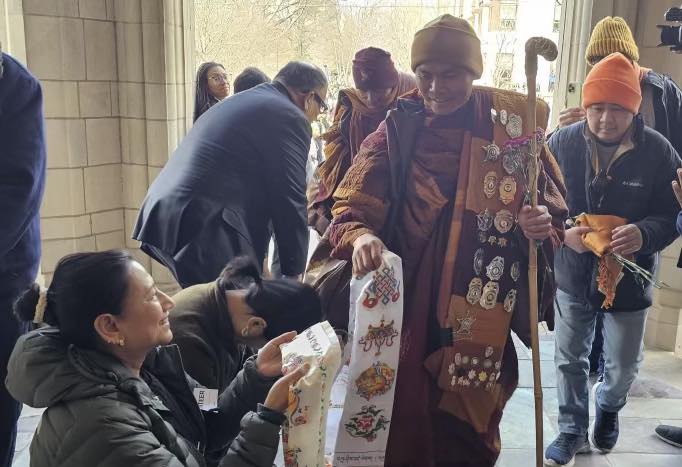
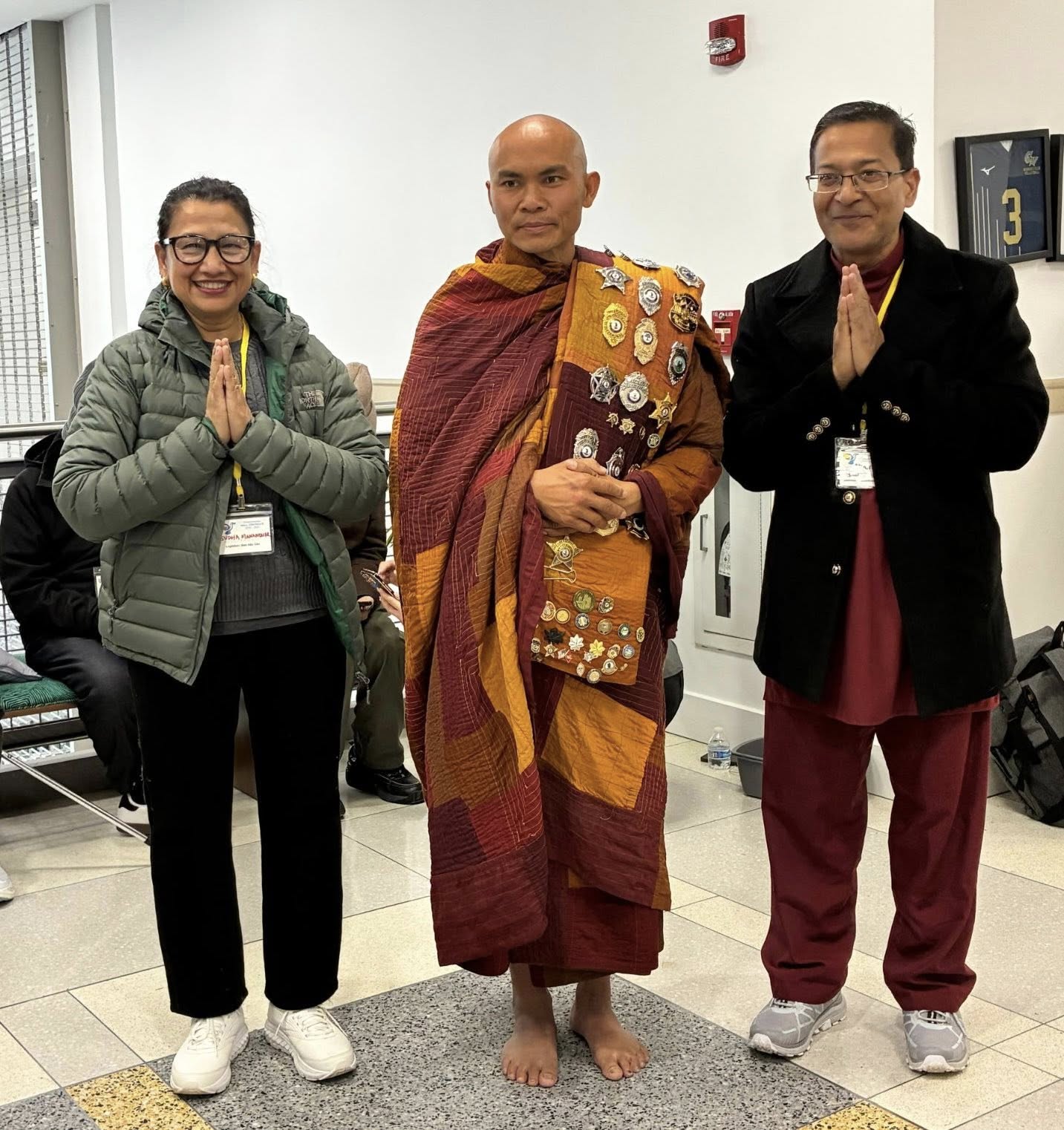
The next day, February 11, we reached George Washington University early in the morning. Bhante Panjakara had two interviews in the morning. So Bhante and Neeraj were busy. At that time, New York State Representative Edward Gibbs had come to deliver the proclamation issued by New York State. But since Neeraj and Bhante were busy, I talked to him for a while. After a few moments, they came and the State Representative read the proclamation. The New York State pin was supposed to be pinned on Bhante's Sanghati robe, but he was a little nervous and asked me for help. I pinned the pin on Bhante Panjakara's Sanghati robe. Suddenly, I got the opportunity to pin the pin on Bhante Panjakara's robe. It was an amazing moment for me. I got the chance to touch Bhante Panjakara's robe. Besides, I will probably never get the chance to touch the robe of Bhante again. This was the greatest achievement for me, walking from Texas to Washington, DC for the peace walk. I think that the accumulated merit of some of my previous births must have given me this opportunity.
Bhante Panjakara is not a new name for me. It is not a new meeting. It is not a new acquaintance. Since 2018, we have been organizing programs related to Buddhism by joining the Nepalese Buddhist Association in Texas. There are about 38 Buddhist monasteries of different traditions in the city of Dallas-Fort Worth. We are working in coordination with all of them. The 2025 Buddha Purnima was celebrated in Austin, the capital of Texas, by the Nepalese Buddhist Association and Bhante Panjakara's Heung Dao Vipassana Bhavana Center. Texas House Representative, Salman Bhojani, had passed a law to celebrate 'Vaisakh Day' on May 15 in Austin. On Baisakh Day 2025, 59 monks from 11 countries participated. But I was waiting to meet the monk Panjakara for the first time after the peace walk began.
Earlier, when I went to meet Bhante Panjakara, Alok (the dog) used to be around Bhante. We already knew that Alok was brought from India during the Nepal-India 2022 trek. When we went there, he was playing in the courtyard of the monastery. At that time, Alok was just a dog, a little different in nature, a little quiet, well-behaved dog, but it seemed that he must have done some good deeds. Now, when I met him in Washington DC, Alok had become a celebrity. Now he is not just Alok, but a celebrity with his own identity as "The Peace Dog Aloka". However, like many, I think that Alok is not an ordinary dog and he must have earned a lot of good deeds in his previous life. For some reason, this life must have been his dog.
After the interfaith ceremony at the cathedral, we reached Lincoln Memorial Park after a two-hour peace walk. There were still snowdrifts along the way. The road was slippery. That day too, the weather was cold. I was wearing a thick jacket. I had a scarf, a hat, and gloves on my hands, but I was still feeling cold. Despite the weather, there were lines of people on both sides of the path where the Bhantes walked. People, children, young people, old people, disabled, sick, and handicapped, were all waiting on the path to have darshan of the Bhantes, regardless of the snow or cold. The Bhantes would also stop the disabled, disabled, and sick people they met on the path and tie them a thread of protection. And, they would recite a prayer, praying for peace. Hundreds of traffic policemen walked along both sides of the path to protect the Bhantes and ensure their march, while police vehicles, ambulances, and hundreds of volunteers walked along. About a hundred Bhantes, and the next group, some with special representative badges, which included me, Krishna, and Ritu. Then the volunteers and other people who wanted to walk all walked to Lincoln Memorial Park. During this walk, I met some Nepali journalists who had already interviewed Neeraj. They also met me in that crowd and expressed their happiness.
The peace walk at Lincoln Memorial Park was the final ceremony. For this ceremony, Bhante Panjkara's Guru Bhante Ratnagun, Bhante Maha Dam Fommasan (who had to amputate his leg in a road accident during the walk), Bhante Samma Maggo (who came from France) also came to join the closing ceremony. At this ceremony, the Dalai Lama also sent a letter of thanks to the peace walk as a worthy cause. At this ceremony, our Nepali origin Lamas also presented a letter of thanks with gratitude. About 50 thousand people stood in this sacred place to participate in this final ceremony, united in unity for peace, awareness, kindness and compassion, united in a common desire for peace. The participants were very sad because now they will not meet the monks on the road, they will not be able to see the monks. Many had tears in their eyes. It was as if something was about to be lost in their daily lives.
At the "Peace Gathering and Closing Ceremony at the Lincoln Memorial", Dr. Neeraj welcomed everyone and said, “This walk is not for any political reason, it is for the spiritual development of all of us, for the inner peace of all, to teach everyone to use compassion, kindness in a practical way.” On this final day, standing in front of the Lincoln Memorial, Bhikkhu Panthkara expressed his heartfelt gratitude to the Buddhist Federation, government officials, law enforcement and emergency responders, religious leaders of all traditions, schools and families, sponsors, volunteers and every supporter who walked with us on this journey. He said, “My friends of the religion, after 109 days, a journey of more than 2,300 miles from Fort Worth, Texas to the Lincoln Memorial in the heart of the United States, amidst cold rain, cold wind and countless silent footsteps, the Walk for Peace has reached its final day. Yet, today is not just about how far we have walked, it is about how deeply we have awakened. Because sometimes change does not begin with grand speeches or historic moments. It begins with a few moments. In a few moments, someone "It can hurt, it can bring about terrible division in a few moments."
He gave us a simple and profound message: But in those few moments, when we live mindfully, we can increase so much harmony, unite, and transform individuals, nations, and the world. Let us look back on this 109-day journey of the Walk for Peace. If we try to live mindfully with each breath we take, with family, love, kindness, compassion, love, harmony, and hope, peace will come within us. After 109 days and 2,300 miles, we stood together in the US capital, completing this journey with gratitude, joy, and hope for a more peaceful world. These moments will live in our hearts forever. Adding to this ceremony, Bhatt Panjakara said, “Our walk ends today, but the journey of peace will never end. Take a piece of paper and a pen. Write this, Today will be my peaceful day. After writing, read it over and over with your eyes. Then read it out loud. Today will be my peaceful day, Today is my peaceful day. Read it out loud to tell the universe that today will be a peaceful day for you. "No one else can ruin it except you."
In the evening, there was a Global Meditation Session with Venerable Panjakara at the Smith Center, George Washington University. This meditation teaching program was broadcast live. This meditation program was participated in by people from all over the world through broadcast. During this, Venerable Panjakara taught the Anapana Sati meditation. Thus, the last day of this historic peace walk was concluded by people from all over the world meditating at once.
Thus, in this historic peace walk concluded by 19 venerable monks and Alok Kukur, the silent power of the venerable monks, along with the monks, was a living prayer for global harmony. This is not a journey of protest, not to convert anyone, but it is a journey of conscience. A journey to call humanity back to morality, responsibility, compassion and awareness. Every moment of tolerance was a selfless offering to a world often filled with noise and conflict. Now the Venerables' walk is over, but the journey of peace for all of us will never end. We Let each being continue the journey of peace within themselves. Standing united for peace, may we also say and practice – “Today is my peaceful day”.

No other posts from this author
Check back later for more content from Dr. Sudha Manandhar

Comments (4)
Wow! Hajur ek writer pani hunuhunxa bhanera aaja thaha payen. Hajur le lekhnu bhayeko Sabai details le Tyo dinko, tyo samayeko pura yaad dilayi dinu bhayo. We must have done some punnyekarma to be able to witness and participate in such life changing event. It is am amazing article di. Thank you for letting me know. ❤️🙏
Write a Comment